
What Neighbors Do

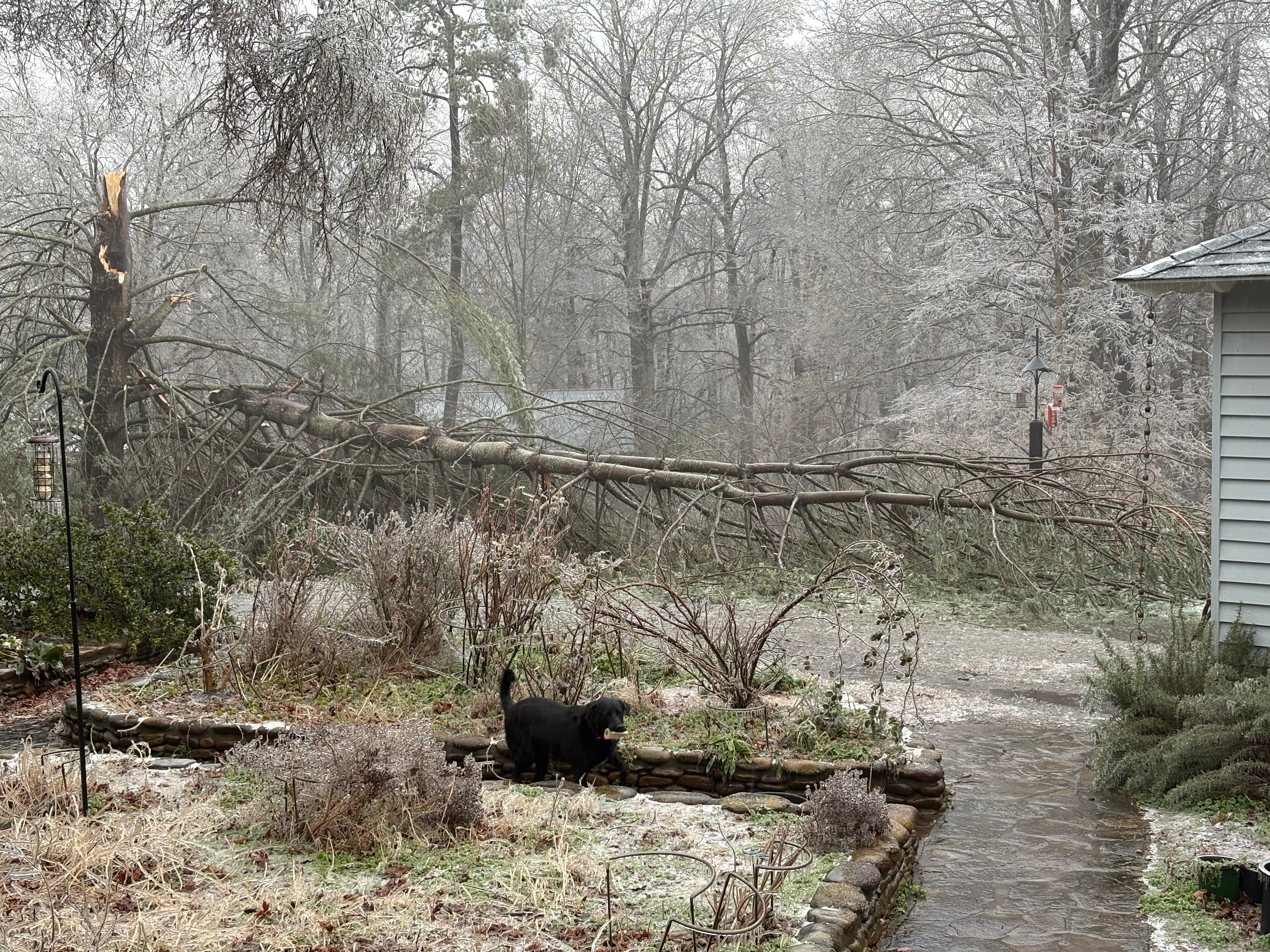
Where I live, people brag about how long their power was out during a winter storm. Most of us have generators or wood stoves and well-stocked pantries. Even if we could get to a hotel that allowed pets, some of ours are too big to ride in cars, and if they could vote, they’d vote to stay home. So we stay home with them and do our best to keep everyone fed, watered, and warm.
The power at my house went off at 8:47 AM on January 25th. Overnight, freezing rain and sleet had turned into a coat of ice on every outdoor thing in my county. By morning, the trees were heavy enough to start falling, taking down utility poles, spilling live wires on the ground, and blocking all roads to town.
Ed had bought the next-to-last generator at Lowe’s the day before, so we had a furnace and refrigerator but no well pump, which meant rationing water in buckets and jugs filled ahead of time. He had also chopped a pile of firewood and pulled the curtains over all the windows, trapping as much warm air inside as possible. The stovetop ran on propane, so as long as we remembered to put a match to the pilot lights, we had hot water. Not bad, I thought, looking around. What I failed to take into account was that the sun had not gone down yet. No-power had not yet joined forces with no-light.
After dark, the wind picked up, slamming the north side of the house with big gusts that shook icicles off the frozen trees outside and sent shards crashing against the bedroom windows. The sound was undiluted with all the machines in the house gone quiet. Even with a pillow over my head, I could hear the crack of what sounded like a gun outside, followed by a commotion of breaking branches and the thud of what could only be a great tree. Every time I started to doze, the cycle repeated, with no way to see what was falling, how close to the house, or how big.
On morning number two, the kitchen looked like the galley of a houseboat that had run aground. I kept tripping over the orange power cord that came into the house through the window over the sink. The counters were piled with dirty dishes. Two outdoor dogs and three cats kept begging to go outside, then bumping into each other at the top of the mudroom steps as they all tried to turn around and come back inside. Every time I swept the floor, the broom delivered a new mix of spilled dog kibble, shed fur, and ripe compost that had missed the bucket. Twenty-four hours felt like a really long time.
Our electricity comes from the Habersham Electric Membership Corporation, established in 1938. That was two years after the Rural Electrification Act passed Congress as part of Franklin D. Roosevelt’s New Deal. Georgians like to think that Roosevelt’s visits to Warm Springs for polio therapy had something to do with it, since that’s where he first spent long stretches of time in a rural area with no electric power.
Back at my house, I realize how much my own sense of power has been affected by the outage. HEMC updates customers every four hours, but the predictions keep moving—from 2:00 PM to 6:00 PM to 10:00 PM, which is when I’d turn out the lights if I had any. Instead, I lie in bed, missing my buffers from the solid thunk of life. When it’s dark outside, I want to flood my rooms with soft light. When the wind howls, I want to turn up the sound on my “Healing Harp” playlist or spend some time with the TV clicker in my hand, debating between All Things Great and Small and reruns of Ted Lasso. Thoreau said he went to the woods because he wished to live deliberately, and here I am longing for distractions.
Suddenly curious about his dates, I discover that Thoreau moved into his cabin on Walden Pond in July 1845, a full 37 years before Thomas Edison opened the first power station on Pearl Street in Manhattan. This is very interesting. I never thought about paying attention to whether an author wrote before or after electricity, but I will now. Those who wrote before lived in a world lit differently from mine. They lived closer to the elements, when a “convenience” meant an icebox or a privy near the house. As much as I like living after, I’ll hear them differently from now on.
On morning number three, Ed and I wake up to see a thirty-foot white pine lying across our drive. The power is still out, and all the outside water is frozen. If we want to haul thawed buckets to the horses, we’ll have to find a way around the pine and take our chances on a downhill slope of ice. While we’re still trying to work up the nerve, my phone blows up with messages between nineteen different people.
Is everyone all right?
The Elrods don’t have a generator and have been cold all night.
We also know the Taylors’ driveway has lots of trees down.
Charles and I are going to both houses with the tractor and chainsaw.
Who else needs help?
We have a generator and the ability to cook.
If anyone needs our house, please let us know.
There’s an elderly man lives alone down the road whose daughter is contacting me.
The sheriff’s sending someone to do a welfare check.
I knew someone would know someone over there since it’s so close.
Jeannie, we have the gas stove on the back porch if ya’ll need to use it.
Good here. We have a wood stove.
I have vodka if it would help anyone.
I don’t know who half of these messages are from, but by the time I find the neighborhood roster and start matching names to numbers, I hear a tractor outside, and see a bunch of people in puffer jackets and orange stocking caps walking toward my house with chainsaws. When I go out to meet them, they tell me they already cleared the driveway. Then they get to work on the white pine, laughing as they haul limbs out of the way and throw balls for the dogs.
By the time I know all their names, they are done. Charles and Rebecca are the last to leave, riding away on their green tractor with a man named Herbie balancing on the three-point hitch in back. Then a young guy named Eli comes back in his pickup truck and says he’s going to the gas station. Would we like him to refill our empty cans while he’s there? Yes, please.
When he comes back with fresh fuel for the generator, he presses a wad of bills and coins into my hand. “Your husband gave me too much money,” he says.
“How about something for your trouble?” I ask.
“No, ma’am,” he says, “It’s what neighbors do.”
He pulls away, and the quiet of the past two days returns, but different now. Without the benefit of electricity, the neighbors have restored lightness to my house. When I look at the sawdust, I hear their laughter. When the dogs bring their slobbery balls to me, I throw them. By the time the power comes back later that afternoon, it’s a relief but not crucial. Thoreau wrote about the three chairs he took with him to Walden Pond, “one for solitude, two for friendship, and three for society”—though when people came in unexpected numbers, he said, “they generally economized the room by standing up.” Or in my case, by showing up at all.
Now that my buffers are back in place, I hope I can remember that. Electricity has been around for ninety years or so, but those three chairs have been around a lot longer, and the power in them never goes out.
Snowmagheddon in Austin Texas. The inside of my house was 40 or less degrees for 3 days. Im sure that sounds warm to those of you who live in the north. But the ice made it impossible to leave the house and suburban means no tractors.
I truly love your story, how it flows, what it tells me. I loved your story from Walking in the Dark, when you walked off the pier? I met you in 2016,and soon after, found the courage to leave "the Church", realizing that the Church is people, not buildings, and without hierarchy. This story describes what I would call, real Church, which might be just a community of people, looking out for each other. Where the "work" of helping is sacred but not overplayed. The work of community is its own reward.
The silence of those few days, without power, resentment brain and my heart, but the darkness was sweet: no "synthetic electricity" trying to interrupt my blood cells from doing their job. No noise from wires that permeate my house. In the first moments, it was relief, my tension left me. But similar thoughts about living without electricity did hit me, too. How creative, how intrepid, those people were, to live (yes, I romanticized them immediately), to not need technology.
BUT...yes, I will read their words in a different way now. Thank you for that reminder.
I am glad you are safe.
I am glad that your family and pets are fine.
I am glad you have good neighbors.
Keep writing.
We need your words.
“It’s what neighbors do,”
said Eli, from Barbara’s ‘hood.
‘Neighbor’ verb becomes.
...
To ‘neighbor,’ show up
bring bread, saws, snow shovels, shawls.
When asked for, sugar.