
The Automatic Earth

When I was an anxious new gardener—sometimes digging up a bulb I had planted the week before to see if it had put out any feelers yet—gardening tips from the gospels kept coming to mind. “Consider the lilies of the field, how they grow;” Jesus once said, “they neither toil nor spin, yet I tell you, even Solomon in all his glory was not clothed like one of these.” Maybe I could ease up on the toil a bit? Or this one: “The earth produces of itself, first the stalk, then the head, then the full grain in the head.” The earth does this automatically. Maybe I could check my sense of indispensability and let some air out of the tires?
In the famous Parable of the Sower, a man with a sack of good seed throws it all over the place, with no apparent concern for what happens once it leaves his hand. Some falls on a beaten path where the birds eat it right up. Some falls on rocky soil so shallow that no roots can grow. Some falls in a thorny thicket that chokes the seedlings before they are even out of diapers. But some of the good seed falls on good soil, and that seed produces abundantly—so abundantly that even though it was just a fraction of what was in the sack, its fruitfulness makes up for all the seeds that didn’t stand a chance.
For me, that’s only part of the good news in this parable. There’s also the sower’s firm grasp of what is within his power and what is not. He gives every kind of soil his best shot, throwing as much seed toward the thicket as he does toward the topsoil, swinging his arm as hard for the rocky outcrop as for the beaten path. When he lets go of the seed, it doesn’t just fly out of his hand. It flies out of his command as well.
This is not the kind of man who camps out with the seed so he’s there first thing in the morning to shoo the birds away. He isn’t the type to lie awake fretting about what will happen if there’s no rain, or too much rain, or what in the world he was thinking when he gave the thorns such a prodigal dose of seed. Instead, he heads home with an empty sack, a light heart, and a sense of release, because he knows this is a partnership, not a sole proprietorship. He has done his job. Now the automatic earth has its job to do. It’s not his job to do both.
This is the sermon I need most to hear in mid-January, when the second arctic blast of the season has swept through north Georgia, nipping the set buds of the hydrangeas and making the leaves of the red maple curl in on themselves. My garden is a wreck, with plastic pots of climbing jasmine that should have been in the ground before the first freeze, and little yellow flags in all the places I was supposed to have dug up the calla lily tubers by now. Looking at my rock-walled wasteland brings on the same feelings as doom-scrolling the headlines or watching a trailer for the latest apocalyptic series on Netflix. I won’t even name the feelings, since you already know them well.
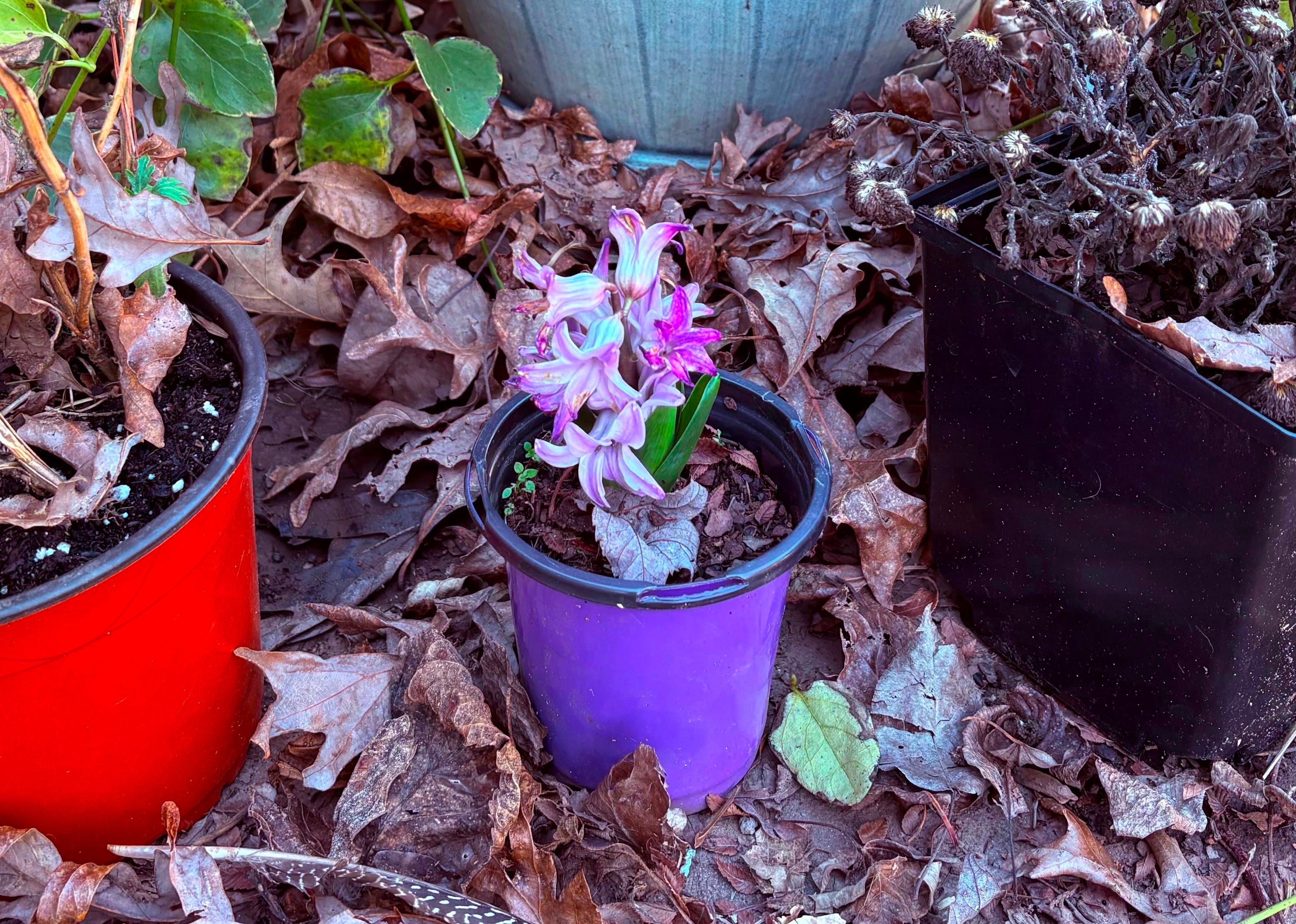
Then, while I am watering the potted asters that have probably passed the point of no return, I see a tiny flash of purple between them, no more than two inches tall. When I squat down to investigate, I see an extra-small hyacinth I bought at Lowe’s back in March or April, gave up for dead in July, and lost track of in the jumble of creeping jenny that hid it from view through the fall. I never put that poor thing in the ground. I never watered it. I totally forgot it was there.
Yet here it is, still in its plastic three-inch pot with a faded price sticker on the side—but full of life now, with a sturdy little spike of bell-shaped blossoms reaching up toward what light there is. It’s like finding a nest of turtle eggs, or a lost chick, only I wasn’t even looking for it. Some other power took care of that small life all these months, or it had power in itself that survived my neglect. This is a revelation, and its effect on me is immediate.
Though the headlines haven’t changed and there’s an ice storm on its way tonight, the automatic earth has come through again, putting me in my place with the sweetest kiss on my over-heated forehead. There is so much coming into this world that doesn’t depend on me. Worrying is a counterfeit form of prayer. I may never stop wanting to change the course of things, but now’s as good a time as any to learn something from the Sower.
You do what you can do as generously as you can. Then you go home with an empty sack and a light heart, because you’re not in this alone. You have partners, both seen and unseen, who work while you sleep, leaving love notes hidden in purple flowers to remind you that they’ve been here, and they will be back.
As much as you might like more than that—the promise that nothing will be lost, that every seed will come to full fruition—that’s not how the garden grows. It grows in the earth, where you can’t see everything that’s happening. Your job is to do your job, leaving open the possibility that it’s only part of the job and that you never do it alone.
Worrying is a counterfeit form of prayer.
Those words were written for me.
And the words about coming home with an empty seed sack and letting others (Another) participate.
Thank you.
Thank you doesn’t begin to convey my gratitude—but I guess it’s enough. Ditto Joel’s comment.