
One Owl's Second Chance

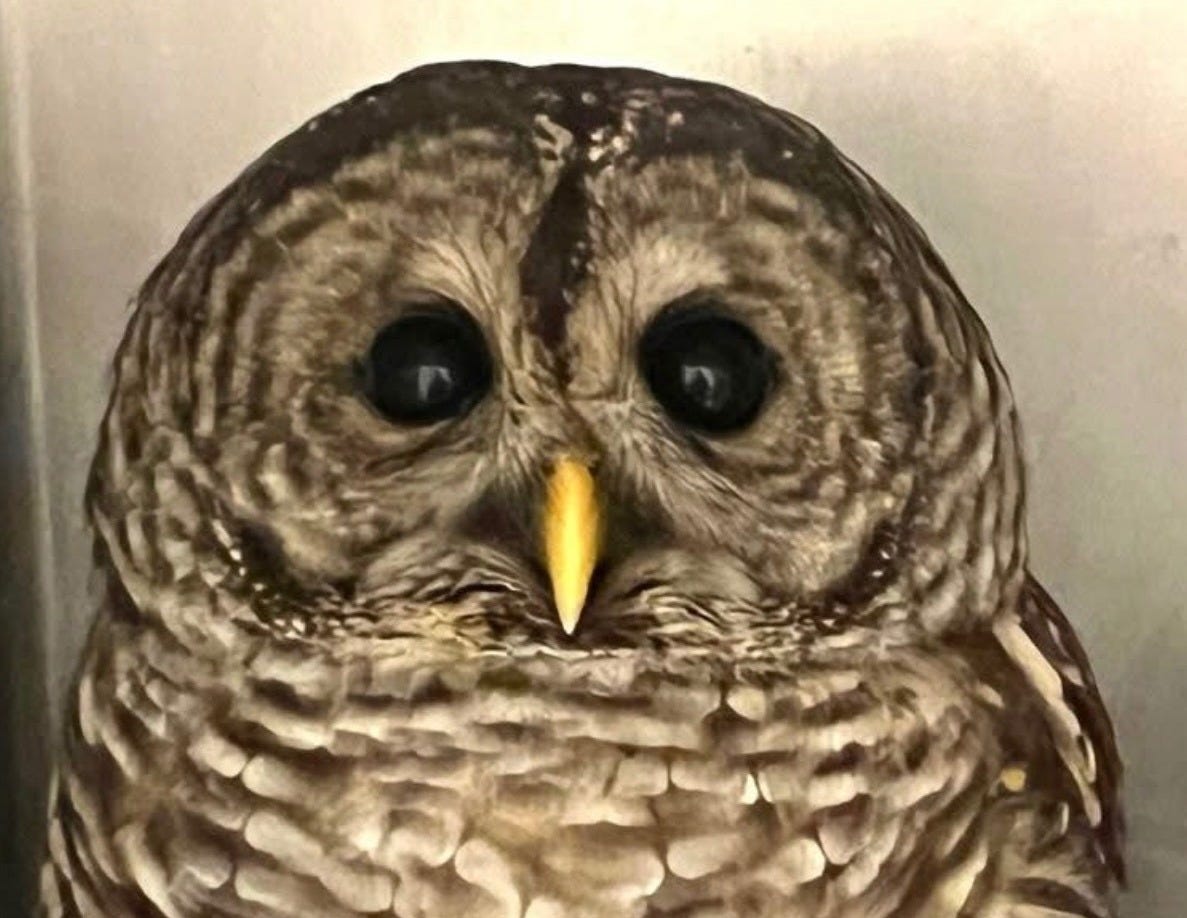
One of the best things about living in a low-density rural area is how much room there is for other creatures to live here, too. I’m not thinking of cows or chickens at the moment, though they far outnumber the humans. According to the 2022 USDA Census of Agriculture, 3.6 million meat or egg-producing chickens live in my county, along with 9,320 head of cattle. When you divide those numbers by the last census of 46,031 humans, that works out to 80 chickens per person and about 20% of a cow.
But those are not the creatures I see when I drive the last two miles home at twilight. What I see, instead, are white-tailed deer, gray squirrels, cottontail rabbits, an occasional raccoon or skunk, and some flattened possums on the road. Once, I saw a big, hairy dog that turned out to be a black bear. Another time, I saw a red fox that moved like a big ginger cat. But the creature who takes my breath away time and again is not on foot but on the wing—a tweed bird that rockets across the hood of my car at dusk with the unmistakable speed and wingspan of an owl.
It happens at the same place in the road every time—a short straightaway in the middle of an S-curve, deep in woods that haven’t been timbered in a long time. This is the owl’s territory, apparently, where our early evening schedules sometimes coincide—me on my way home from town just as the owl sets out to find supper. I can’t tell whether it’s a he or she, both because it flies above my headlights and because even an experienced birder would have a hard time deciding in the single moment the bird speeds past my windshield. All I can tell you is how relieved I am not to hear a thud, and how the thrill of that split-second encounter makes my skin prickle all the way home.
In early December, my long-time friend Claire, who rehabilitates raptors at the Chattahoochee Nature Center, let me know that an owl had been hit by a truck on a road near my house—not killed, but hurt badly enough to need help. After the bird arrived at the Center, Claire sent me a photo of the admission report: an immature Barred Owl with a concussion, hemorrhaging behind the eyes, bruised ears, and pain in the left wing. Below the report was the mug shot of a sweet-faced young owl looking straight at the camera with eyes as round as black marbles. If not for the golden beak just beneath and between those eyes, it would have been hard to tell where the orb of his head became his body. Does everyone want to reach out and touch an owl like that?
Claire’s a pro, so she knows better and has the scars to prove it. She also sees a lot of Barred Owls, who are not only the most common species in north Georgia but also do their hunting at dawn and dusk. This puts them on a collision course with commuters driving to and from work, especially when the time changes in the fall. Overnight, human rush hour is an hour darker than it was the day before, but the owls never got the memo. Of the 140 owls received by the Nature Center in 2025, 109 were Barred Owls.[*]
The Clarkesville owl was lucky. He accepted food from humans. His wing was bruised but not broken. He responded to medication. About a month after Claire first told me about him, she called to say he was ready to be released—as close to where he was found as possible, about a mile from my house. Would I like to come see?
I would. So would my husband Ed, who is Claire’s father, along with two ten-year-old girls and their mother, who knew Claire from Thanksgivings at my house.
That made five of us in the welcoming party, all vibrating with excitement when Claire opened the hatchback of her Bronco and lifted a big black box out of the back. She looked around, saw a spot she liked, and led us up a hill with a field on one side and a pine forest on the other. It was beautiful up there, but no one had eyes for anything but the box.
After briefing us on what would happen next, Claire tugged on a pair of thick black gloves that went halfway up her forearms, reached into the box, and lifted a Barred Owl out into the light. She held him by the legs so she knew where his talons were, but he still tried to go AWOL a couple of times before fluffing his feathers and settling. When he had his bearings, Claire pulled off one glove with her teeth to show the twins where his ears were. “Can you see them?” Claire asked, pushing aside a patch of feathers just behind the corner of the owl’s left eye. The girls leaned in with long necks and wide eyes before whispering, “Yes.” They could see.
I think it’s fair to say that everyone standing around that still-wild bird on Claire’s arm was split right down the middle. We were all there to celebrate him leaving us behind, yet none of us was ready for him to go. Couldn’t we say goodbye for another hour or two?
It’s a good thing Claire was in charge, not us. She didn’t even count to three before bending her knees, jumping so high that her feet left the ground, and heaving the owl high into the sky. Without missing a beat, he opened his long wings the instant he knew he had his legs back and flew to a branch twenty feet above our heads. After looking down at us just once, he smoothed his feathers. Then he swiveled his head around to see where he was. When we left, he was still there, though harder to see. He was already blending back into the edge between the field and the forest.
His flight to freedom only lasted five seconds. I counted the video twice to make sure, but it’s still happening in my mind. It may never stop happening in my mind. The strong wing beats after so many weeks in a cage. The great arc of those wings against a blank gray sky. The sure sense of direction to a perch the same color as his feathers. The safe landing after a danger so recently survived, and the kind woman on the ground who brought him back healed to begin his life anew.
I’ve lived long enough to know the danger isn’t gone for good—how could it be, with so much fragile life on the wing?—yet what a great gift, to be in that small congregation on a gray winter morning, watching one Barred Owl take his second-chance flight into more life.
[*] With special thanks to Kathryn Dudeck, Wildlife Director at the Chattahoochee Nature Center, for sharing this information with me.
I’m so glad there was this to read in my inbox this morning. It was a story, it was a knell, it was a metaphor, and it was a prayer. Thank you for sharing.
For some reason, I am also most fascinated by owls. There are also many here in Montana, but I have only seen one in the wild, and that one, for some reason, was perched in a tree outside our county courthouse. In West Yellowstone, near the park, they have a grizzly and wolf recovery center, and they also have some owls. I always make sure to see them there.