
Meetings with Bears

The first time I found the steel post of my bird feeder bent in half, I could not imagine what had happened. Had the material been flawed? Had a heavy branch fallen on it and bounced out of sight? When I got closer, I saw the metal tube of the suet feeder squeezed in the middle like an empty toilet paper roll and realized that something with jaws had done this.
Of course, I knew there were black bears in my area. They’re the only species native to Georgia, and I live in one of the three main places where they live, too. I just didn’t know they ate birdseed, or that they would come so close to a house with three dogs to score some. If you live in bear country, you’re laughing at me right now. There’s a first time for everything.
When I checked with the Department of Natural Resources, they told me that black bears pack on the pounds in late fall before they go into “a state of torpor” in their winter dens, and that I should put my bird feeders away until then. This was for my safety as well as theirs, they added, since bear hunting season is timed to coincide with bear feeding season. From mid-September 2025 to mid-January 2026, any licensed hunter in Georgia who follows the rules can kill two adult bears in my county, close enough for me to hear.
After my initiation, I kept a better eye on the fall calendar, doing my part to keep a fed bear from becoming a dead bear. A trail cam on the far hill of my place had caught a mother with two cubs in the viewfinder over the summer, so I knew they were around. As much as I never wanted to meet them in person, I longed to see them up close. Their presence proved how much life the land could sustain. Their power made their tenderness with each other all the more touching. Their wildness made my civilization feel like a tight fit.
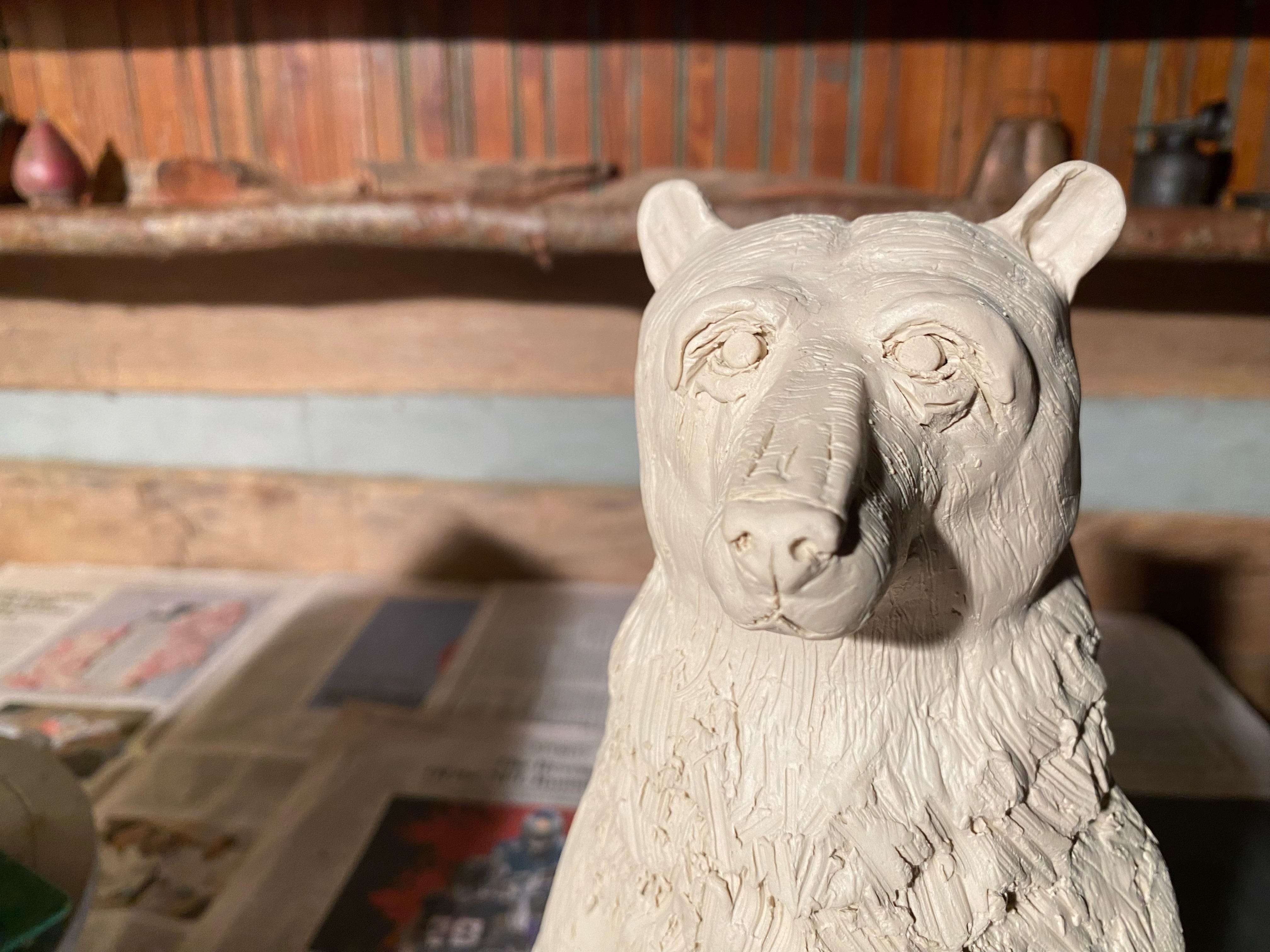
Now it is late October, and I have just returned from a clay sculpting workshop that I circle back to every year. The first year, we made ravens and owls. The second year, we made hares. This year, we made bears. Mine started out as a giant sweet potato body with a one-inch collar where its neck would be and a round pinch pot for its head. Four thick pillars that would become the bear’s legs went under that, along with a pedestal of clay to keep the whole thing from sagging in the middle until it had hardened enough to stand alone.
Over the next three days, the bear came into being. Keeping one eye on photos of real black bears and the other on what the people around me were doing, I added pads of wet clay that became shoulders, rump, snout, and feet, stroking them into place with any finger the right size. When my teacher came over to check on me, she looked at the bear first. “Hello, lovely,” she said to it. “Oh, there you are.”
Then she did her magic, which was to find the centerline of the bear’s head with her thumbs, then the jawline, then the line where the neck became shoulders. She was seeing the bear, not thinking it. She was finding the bear in my pile of clay. After that, I could see better too—how the ears needed to move further back, how one cheek wanted more fullness, how the slight turn of the bear’s head would make the muscles on one side of its neck stand out more than the other.
I was finally seeing a bear up close, and in a way I cannot explain to you, she kept letting me know how she was made. More chest here. Less hip there. My feet are shorter than that. Make the ankle bend deeper. Wet your hand and run it down my back. Feel my spine? The fur hides a lot. There’s more to me than you think.
The toenails took me more than an hour—all twenty of them—and the tail less than five minutes (so small!) I thought the body was finished after that, but when I cut away the support pedestal underneath, I saw the problem at once. My bear needed a belly, especially in October. Realistic or not, she wasn’t coming into the world looking hungry. I added one round pat of clay to her flat stomach, then another, then one more. When all three were pressed into place and rubbed smooth, she filled my palm like a ripe plum.
Prior experience taught me to save the eyes and nose holes for last, since something changes after that. Once a creature you have made can look back at you, the power differential shifts. There are two of you now, accountable to one another. The maker and the made have a permanent bond.
That’s how it is with this bear. As small as her eyes are, they are on me now. All that’s left is to open her nostrils, along with the comma-shaped slits at the side, and let out the breath I have been holding here at the end. My end, her beginning. Now that I’ve seen her up close, it’s clear this exercise hasn’t cost her any wildness. If anything, she’s put her paw on some in me.
If you ever get a chance to do this, do this.
The way we behold the seen and unseen in each other can make a difference in how we come alive. You brought this new thing—sculpting, with clay—alive for me, Barbara, thank you. As I finished reading, I suddenly became aware that my mouth was agape. Thank you for saving the bears.
Delightful essay!
I do wish hunting for sport were banned.