
Live Nativity

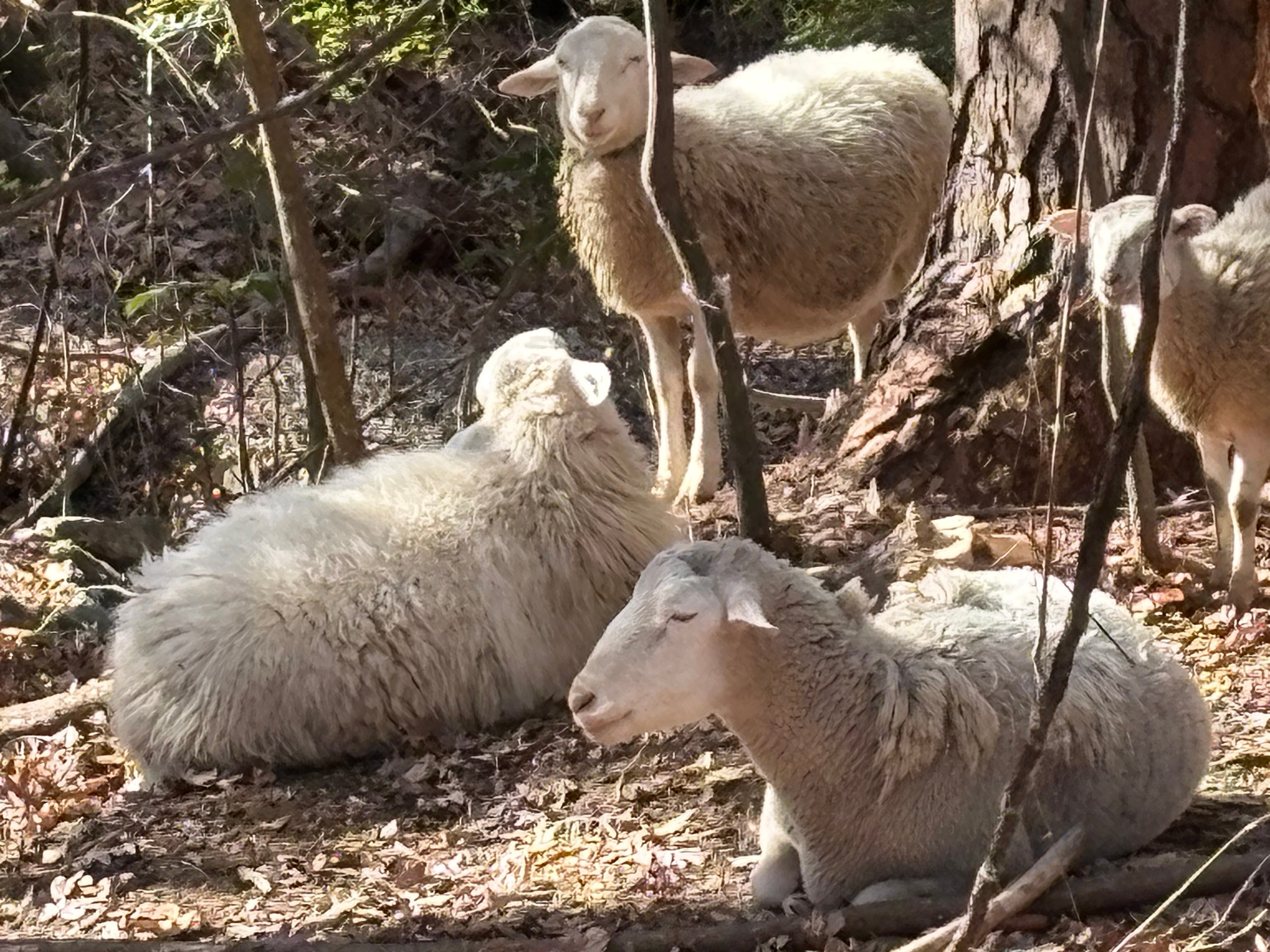
When my friend Martha sent me a photo of sheep grazing in a dappled forest, I assumed she had found it online, since that’s how we do things. She sends me photos of elephants sliding down muddy hillsides for fun; I send her photos of Jack Russell Terriers riding horses. Artificial intelligence has made our jobs harder, since we want to astound each other with creatures that live and breathe in the same world we do. As lovely as some of the manipulated images are (like the mama bird who lifts the feather ruff around her neck to make an umbrella for her babies), they are lovely lies, and there are already enough of those around.
There was no question that the sheep in Martha’s photo were real. One of them was missing a horn. Another had some serious dreadlocks. The one with the blue collar was the mother of the sheep, Martha said, whom the others—a flock of fourteen or fifteen sheep—followed around. She knew this because she could see them from the eighth floor of the retirement community where she lives, which is famous for the ten-acre wildlife sanctuary at its heart.
At the meet-and-greet with residents when the sheep first arrived, the shepherd explained that they were there to do some ecological landscaping in the sanctuary (his company is called “Ewe Can Do It Naturally”). Over the next several weeks, the sheep would clear the grounds of privet, kudzu, English and poison ivy with no whining motors, fossil fuels, or herbicides involved. All the sheep would need was water, hay, and time—plus some of the small pumpkins that were their favorite treats.
If the weed-eating was all that the sheep got done during their winter residency, it would have been plenty, but when one of the ewes dropped twin lambs during the first week of December—a white one with a black spot on his neck, and a black one with a white star on his head—the very young animals brought some very old humans out of doors for the first time in ages. “Lamb alert!” Martha texted four days later. “Nine more mother Mary sheeps (sic) are due in next couple of weeks. We’re installing a LAMB CAM.”
I had to go see for myself.
When I arrived late one afternoon, Martha and I walked a winding path past where the sheep had been a few weeks back. All of the plants that hadn’t belonged there in the first place were gone. There was no riot of vegetation, no tangle of vines. The trunks of the tall trees rose up from a lush brown carpet made of their own leaves and mulch. It reminded me of a documentary I once watched about artists who restore original paintings hidden under centuries of grime, with one obvious difference: the artists needed a great many tools and potions to do their painstaking work, while all the sheep needed were strong lips and good appetites.
As Martha and I kept walking toward where she had last seen the flock, I saw the row of pumpkins along the fence before I saw the sheep behind it. “The gardener chops them up with a machete when it’s time for a treat,” she said, but at the moment it seemed to be time for a nap. Sheep were dozing in spots of late-afternoon sunlight filtering down through trees. Seven of them were spaced out under a massive pine. One had chosen a spot apart. The twins were nowhere to be seen, but I didn’t try hard to find them. The resting sheep put me at rest, too. I caught their peacefulness and didn’t want to look away. Was it all the Bach I had listened to, all the nativity scenes that leaned against the walls of my memory? Or was it a natural gift sheep had, to calm humans down like that?
Whatever it was, it was contagious. As Martha and I stood watching the flock, other people joined us, speaking softly, pointing out sheep they recognized and wondering who would give birth next. Some of the people had pets with them, but there was no barking, no running the fence. Leashes fell slack as the dogs sat and watched with us, some of them pressing their noses through a square of fencing and sniffing the soporific air. “We love the sheep because they’re gentle,” Martha said, “and they gentle our animals.” The sheep are also safe, I thought. Where sheep may safely graze, all creation breathes more easily.
That was a week ago now, and still no more babies. I text Martha so often that I’m surprised she still answers me. Her last update read, “I look out the window every minute or two, but so far they’re all waiting for Christmas Eve. Bellies big on the two I can see.”
Everyone is waiting for something wonderful to happen.
So many words of wisdom in your story. One sentence keeps repeating in my head - “Where sheep may safely graze, all creation breathes more easily.”
Beautiful - so much to ponder. I get glimpses of deeper meaning than the words on the page. I’ll get there when my soul makes clear what it wants me to know. Patience. Grace.
Thank you ~