
Feed My Sheep

I don’t have any sheep. I had three llamas once, who flinched when I touched them and spat at each other when I put their food bowls too close together. They also had to be tackled every 28 days for worming and toenail trimming, a two-person job that usually involved more spitting. I am sure other people have better relationships with their llamas than I had with mine, but mine were a pain. Once, when I was ready to give them away, Ed said, “Do they make you laugh?” That was all it took. They stayed with us for the rest of their lives.
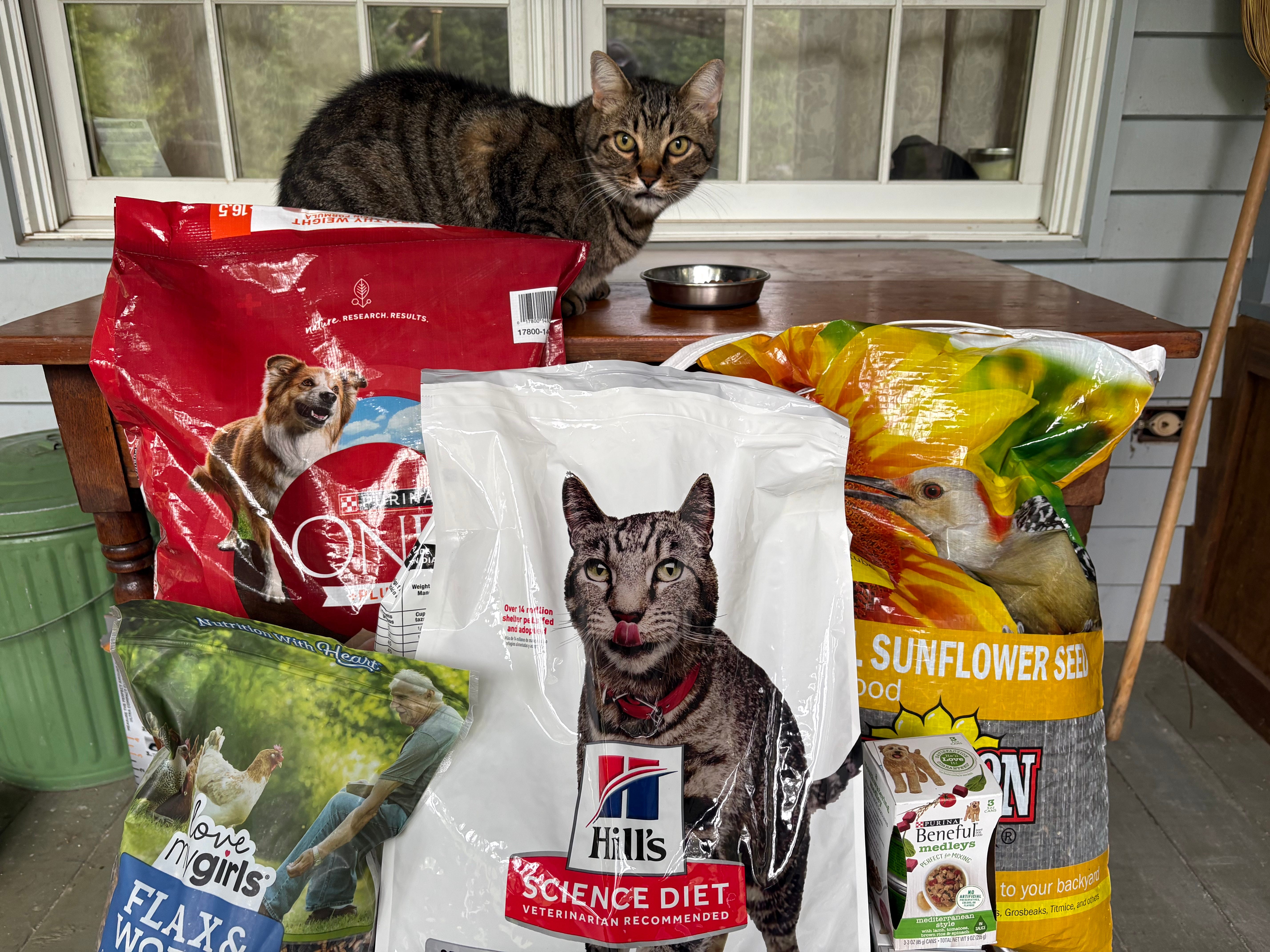
Now the domestic animals at my place are all the usual suspects: barn cats, house cats, dogs who wandered into the yard, retirement-aged horses, chickens from the feed store, and a dwindling flock of guinea hens. It’s been a big family for a long time, but since I decided early on to take a pass on human children, it’s how the mother in me shows up every day. There are a lot of bowls to fill, and no days off.
Last week’s relentless heat hit me like a wet bed sheet. A five-minute walk to the mailbox called for a dry bandana to keep the sweat out of my eyes. Weeding was out of the question. The bird feeders I could see through the kitchen window emptied slowly and then hung derelict with no breeze to blow them around. What was wrong with me? The least I could do was keep food in front of the creatures, no matter how hot it was outside.
Since I could do math without leaving the air-conditioned house, I decided to count how many meals I serve most weeks. Two dogs + three cats x 2 meals a day x seven days a week = 70. Two horses + three chickens + five guinea hens x 1 meal a day = 70 more. Two humans x 2 meals a day = 28, for a total of 168. These are rough figures, once you take leftovers into account, along with the fact that the guineas share one scoop of feed each night—but I didn’t include the bird feeders or the hummingbird bottle feeder, not to mention the bird baths and water bowls that always need refilling.
Though I started the tally in order to feel righteous, all I felt when I got to the bottom line was relief. No wonder I was so tired. It really was a lot to do, but I had never put any of it on my to-do list before. Because feeding doesn’t count, does it? What counts is making the plane reservations, replacing the air filters, cleaning the guest room, and answering the mail. What counts is remembering the dentist, meeting the deadline, getting the oil changed, and finishing the income tax return. When I retired from teaching years ago, the prescient woman in the mailroom said, “You’ll wonder how you ever had time to work.” Now I know that all depends on what you count as work.
Feeding isn’t, deep down. God knows I sweat doing it, but when I stop focusing on the labor involved, it feels more like love transmuted into hay bales, senior feed, pricey kibble, and scratch grains. It comes in cartons, sacks, and reusable grocery bags. That’s how the feed passes through my hands, anyway. It rounds back to me in soft bodies brushing my legs, licking my face, and turning toward me when I call. If those intimacies are all about food, I’m okay with that. They feed me too.
A friend and I once agreed that no matter how many things are on our daily to-do lists, we never manage to get more than three of them done. That doesn’t stop us from making the lists, but it somewhat diminishes their power. Every now and then, one of us texts the other, saying, “Eighteen today!” followed by “Only got two done.” A laugh emoji comes back, sometimes the one with tears.
Just lately, I’ve thought about making another list at the end of the day, writing down what I did do instead of noting what I didn’t. Feeding still won’t make the list, unless eating and breathing do too, because keeping the meals coming doesn’t feel like a chore that can ever be checked off. Whether you do it for a child, a partner, a stray cat, or a community kitchen, feeding feels more like a vocation—a way of mothering what’s right in front of you, should you happen to sense that call.
Maybe this helps when it’s hot outside and you want a day off, maybe not. What it does for me is bring the llamas back to mind. Those rough beasts never even winked at me with those long eyelashes of theirs. All they did was dodge my touch and spit at each other with such stiff-necked offense that they made me laugh every time I fed them, for being entirely who they were. Meal time was also the only time they let me close to them—always at risk of being caught in their crossfire, but still—it made feeding them worth doing, over and over again.
It appears to me that we human-types might be a lot like your llamas - we often don't let others close to us and instead spit on each other. We are such a odd group of critters. But we (humans) should/could also be included on your list of those you have fed, nurtured, and guided us to a deeper understanding of life, love and being human. Your words, in Coming Down to Earth and in your numerous books, have enriched and led us to see life in different ways that we might otherwise ignore or downright miss. Huge Thanks for who you are and your willingness to share yourself with all of us hungry critters.
Thanks for the smile and for the reminder of why I do most of what I do.